Below is the output from your job:
Input longitude: 340.0 deg

Input latitude: 0.0 deg

Input velocity: -35.0 km/s

Input velocity error: 5.0 km/s


Method A: Traditional kinematic distance, Brand & Blitz (1993) rotation curve, IAU-defined solar motion parameters.

Galactocentric radius: 5.80 kpc

Near kinematic distance: 2.97 kpc

Far kinematic distance: 13.01 kpc

Tangent point kinematic distance: 7.99 kpc

Galactocentric radius of tangent point 2.91 kpc

LSR velocity of tangent point: -139.0 km/s


Using Reid et al. (2014) solar motion parameters to correct LSR velocity.

Corrected LSR velocity: -34.47 km/s

Corrected LSR velocity error: 5.74 km/s


Method B: Traditional kinematic distance, Reid et al. (2014) rotation curve and updated solar motion parameters.

Galactocentric radius: 5.80 kpc

Near kinematic distance: 2.78 kpc

Far kinematic distance: 12.89 kpc

Tangent point kinematic distance: 7.84 kpc

Galactocentric radius of tangent point 2.85 kpc

LSR velocity of tangent point: -117.9 km/s


Warning, cannot import Cython kernel functions, pure python functions will be used instead

convert-im6.q16: profile 'icc': 'RGB ': RGB color space not permitted on grayscale PNG `jobs/1957/340.0glong_-34.46921216535963velo.png' @ warning/png.c/MagickPNGWarningHandler/1667.

Method C: Monte Carlo kinematic distance, Reid et al. (2014) rotation curve and updated solar motion parameters.

The errors (+XX / -YY) represent the 68.3% confidence interval.

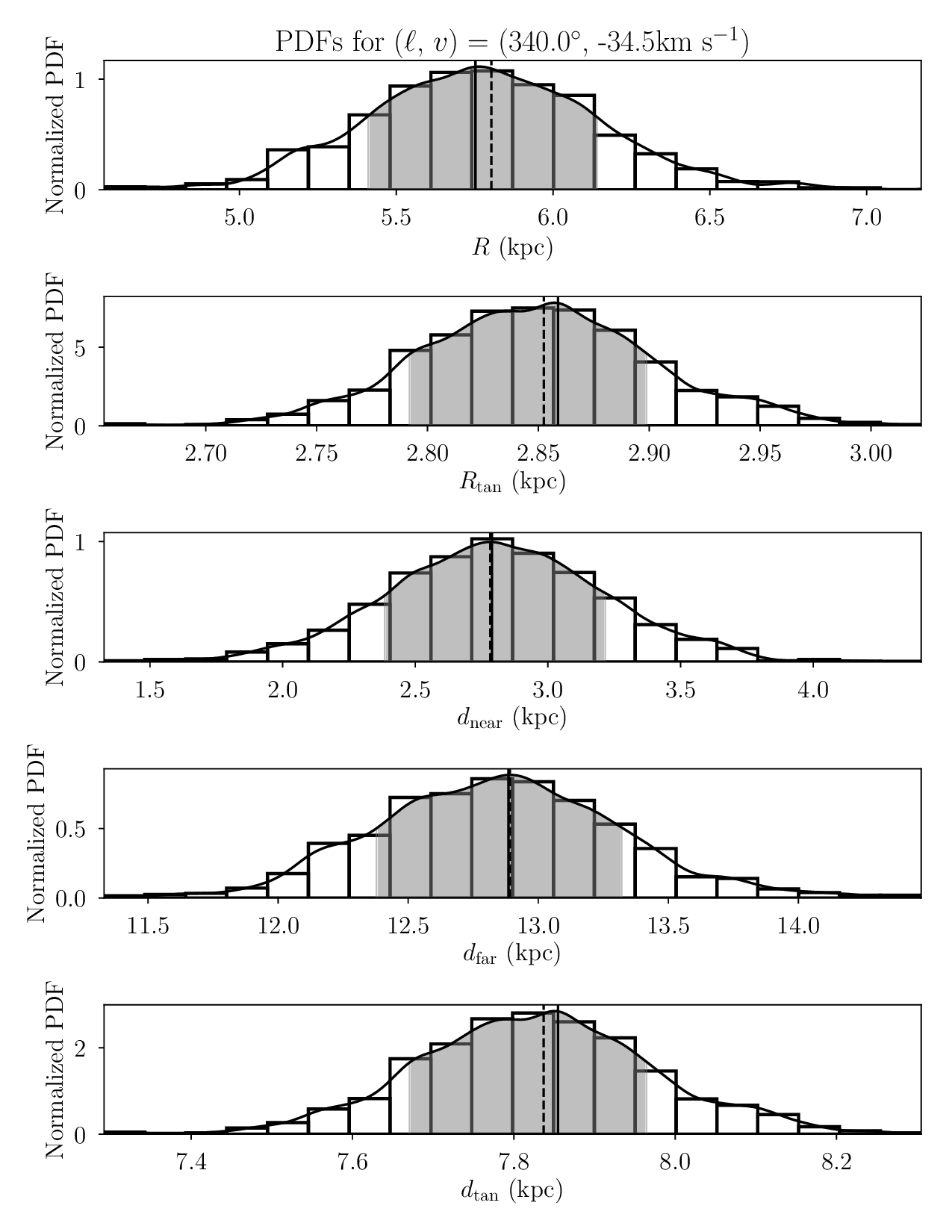
Galactocentric radius: 5.75 (+0.39 / -0.34) kpc

Near kinematic distance: 2.79 (+0.44 / -0.40) kpc

Far kinematic distance: 12.89 (+0.44 / -0.51) kpc

Tangent point kinematic distance: 7.85 (+0.11 / -0.18) kpc

Galactocentric radius of tangent point 2.86 (+0.04 / -0.07) kpc

LSR velocity of tangent point: -121.2 (+16.8 / -8.9) km/s


Done!
Method C Probability Distribution Functions:
Download as PDF
These figures are the probability distribution functions of the Monte Carlo kinematic distances: Galactocentric radius (R), Galactocentric radius of the tangent point (Rtan), near kinematic distance (dnear) far kinematic distance (dfar), and tangent point kinematic distance (dtan). The data are the distributions of the Monte Carlo samples, the solid curve is the kernel density estimation (KDE) using the linear combination technique from Jones (1993), the dashed vertical line is the Method B kinematic distance, the solid vertical line is the peak of the KDE and the Method C kinematic distance, and the gray region is the 68.3% confidence interval (the errors on the Method C kinematic distance).